
The development of quantum mechanics and computing has unfolded through a series of landmark discoveries and technological breakthroughs. Early 20th-century scientists like Niels Bohr, Wolfgang Pauli, and Werner Heisenberg laid the foundation of quantum theory, transforming our understanding of atomic behavior. Bohr introduced the concept of quantized energy levels for electrons, while Pauli and Heisenberg expanded on these ideas with quantum superposition and the uncertainty principle. These principles reshaped physics, leading Albert Einstein, Boris Podolsky, and Nathan Rosen to propose quantum entanglement in 1935—a phenomenon now integral to quantum computing.
Quantum computing’s origins can be traced to theoretical ideas in the mid-20th century, particularly Alan Turing’s 1951 proposal of a quantum-based machine that could surpass classical computers in specific tasks. However, it wasn’t until Richard Feynman’s work in the 1970s that quantum computers were truly conceptualized as universal simulators capable of modeling complex systems. The 1980s saw further advancements with the quantum Turing machine proposed by Paul Benioff and David Deutsch’s groundbreaking quantum algorithms. Deutsch suggested that quantum algorithms could solve certain problems more efficiently than classical computers, foreshadowing Shor’s 1994 algorithm for integer factorization, which posed a potential threat to classical encryption systems.
Experimental strides in the 21st century made quantum computing a practical reality. Notable achievements include the launch of the D-Wave 2 in 2013, one of the first commercially available quantum computers developed by Google, NASA, and D-Wave Systems. This system applied adiabatic quantum computing to tackle optimization problems. Then, in 2016, IBM introduced a cloud-based platform allowing users worldwide to experiment with quantum computing using a five-qubit processor, effectively democratizing access to this cutting-edge technology. Another milestone in 2017 involved Yale University’s creation of error-correcting qubits, a key step towards fault-tolerant quantum computing.
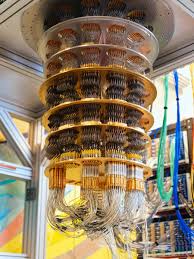
As quantum computing progresses, its intersection with AI has sparked both excitement and concern. The Turing Test, proposed by Alan Turing, remains a significant benchmark for assessing machine intelligence. However, recent developments in AI—especially large language models such as GPT-4 and Google Bard—reveal the limits of AI’s understanding, as these systems lack an inherent sense of truth or accuracy. Physicist Michio Kaku points out the dangers of AI pulling in unchecked data and spreading falsehoods. The fusion of AI with quantum computing might address these issues by creating systems that can fact-check data, offering a new level of reliability in AI responses.
Quantum computing could offer a solution to AI’s accuracy problem by using its immense processing power to filter through vast data and verify facts. Kaku envisions quantum computers as fact-checkers, capable of distinguishing between true, false, and ambiguous information with varying degrees of confidence. This capability could enhance the integrity of AI outputs, but it also raises ethical questions about who controls this technology and determines what constitutes truth, highlighting the need for impartial frameworks to manage AI-driven information.
The potential of quantum computing and AI collaboration extends to transformative applications. Future predictions suggest that quantum-enhanced AI could significantly impact fields like space exploration, where quantum computers might aid NASA in finding Earth-like planets. This technological synergy is likely to reshape industries, push scientific boundaries, and challenge our perception of intelligence, making it essential to anticipate and address the implications of these revolutionary developments.